
When founders, CEOs, and executive leaders come to us for help with leadership development, the need almost always comes down to one of two things: succession or scale.
The founder is thinking about an exit and wondering who is ready to carry the business forward. The company is in high growth, and its leaders are struggling with the added complexity. Or the business has to change to operate at a higher level of maturity, and its leaders have to take it there.
Now, that’s not how they say it.
What leaders tell us
“I’m trying to figure out what’s next for me, and for the business?”
“I’ve worked hard to develop my exec team, but they don’t seem to know how to develop their own teams.”
“I stepped away to open a new location, and things started to slide.”
“It’s not their technical skills. It’s their attitude about leading.”
“Our VPs keep looking to us to solve problems instead of collaborating across the business.”
“We’re not changing fast enough, and our leaders don’t have a sense of urgency.”
So, they invest. They bring in a coach or a leadership program for their team and even themselves. Then they wait, hoping to see change. It often does, in individuals and in some teams. But progress is uneven, and over time the energy fades. Development can become something people comply with, not something they commit to.
I know this pattern myself. At times, our senior team feels the weight of increasing strategic and operational complexities in a fast-growing business. But our response is to lean into developing ourselves together!
Your role in everyone else’s development
Succession and scale depend on the same thing: leadership capability that reaches well beyond the top team. Coaches and programs help build it, but what’s often missing is the senior-most leader’s awareness of the influential role they play in everyone else’s development.
When a senior leader treats their own growth as a discipline they personally own, the way they own the numbers and lets their people see it, the development investment the company is making in individuals and teams starts to work harder. The leader’s sponsorship becomes credible. Their standards become contagious. Their teams stop treating growth as something that happens only in a workshop or a coaching session and start treating it as part of the job. This is the essence of leader-led development.
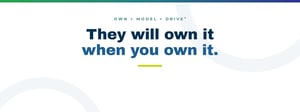
The phrase we keep coming back to at AO is simple: They will own it when you own it.
Your people take every cue from you
In any organization, people look to the top for signals about what is valued, tolerated, and rewarded. They watch how you handle a mistake, how you take feedback, and whether you ever say out loud, “I’m working on getting better at this.”
A leader who keeps their development private is, without meaning to, teaching their team that growth is something to hide. A leader who shares it, imperfectly and in real time, sends a message no program or policy can match: this is what safe, serious growth looks like here.
I find that both humbling and hopeful. Humbling, because the work starts with us. Hopeful, because the most powerful lever in leadership development is one every leader already holds.
Three movements, one discipline
This is the idea behind OWN+MODEL+DRIVE®, a leadership orientation and framework we’ve built from our own experience and from years of work with founders and executive teams.
| OWN | Hold your own development with the same rigor you bring to the P&L. |
| MODEL | Make your growth in leadership capability visible to everyone watching. |
| DRIVE | Build standards, routines, and systems around you, so it holds without you. |
Each one builds on the one before it.
Why this matters now
As AI takes on more of the knowledge and transactional work inside organizations, the skills that remain most valuable are deeply human: using good judgment, the ability to build trust quickly, and being steady and present in challenging situations. Those skills don’t scale through a program alone. They scale when leaders build them in themselves first, model them, and then build them into the culture of the organization.
Leadership capability has always been shaped by the leaders at the top. AI exposes how well those leaders understand their role in owning, modeling, and driving leadership capability at scale. At AO, we believe this orientation is what founders, CEOs, and executive leaders need to harness to scale leadership excellence across their companies.
One question to sit with
Here is the first statement from our OWN+MODEL+DRIVE Self-Check.
Rate yourself honestly, from 1 to 5:
Self-Check · OWN · Statement 1
I hold my own development with the same rigor and regularity I bring to the P&L.
12345
1 = Rarely true of me · 3 = Sometimes true of me · 5 = Consistently true of me
If your answer gave you pause, that pause is worth paying attention to.
Scaling Leadership Excellence
white paper + 5-minute Self-Check
Scaling Leadership Excellence
The full Self-Check takes about five minutes, and our white paper, Scaling Leadership Excellence, lays out the framework.
I’d love to hear where you land.
— Catherine, Co-Founder & Chief Impact Officer